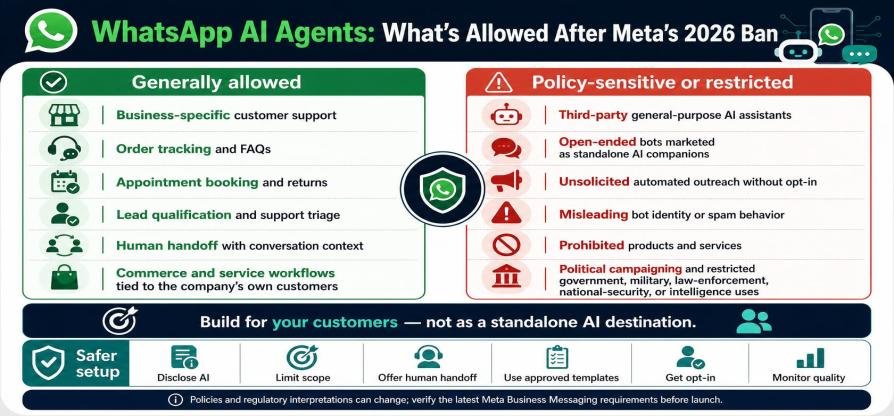
WhatsApp AI Agents: What’s Allowed After Meta’s 2026 Ban
- 04 Oct, 2026
WhatsApp AI Agents: What’s Allowed After Meta’s 2026 Ban
Meta's updated WhatsApp Business Solution Terms strictly enforce clear boundaries on how Artificial Intelligence can be deployed on the WhatsApp Business API. While headlines announcing a "WhatsApp AI Ban" caused widespread concern among marketers, the reality is more nuanced: Meta has prohibited general-purpose, open-domain AI chatbots while fully supporting and encouraging task-specific, business-driven AI workflows.
Understanding these rules is critical to operating safely without risking account suspension or API access revocation.
                        META's 2026 AI POLICY FRAMEWORK
                                       │
            ┌──────────────────────────┴──────────────────────────┐
            ▼                                                     ▼
  [ BANNED: Open-Domain AI ]                           [ PERMITTED: Business Purpose AI ]
  • Open-ended "Ask Anything"                           • Lead qualification & scoring
  • ChatGPT/Perplexity wrappers                         • Order status & tracking updates
  • AI acting as primary product                        • Appointment scheduling & support
  • Models trained on user message data                 • Guardrailed contextual Q&A
1. The Core Policy Breakdown: What Meta Actually Banned
Meta’s revised terms differentiate between using AI as a distribution wrapper for an AI product versus using AI as a utility tool to deliver a business service.
Banned Use Cases (Non-Compliant)
General-Purpose AI Assistants: Any bot whose primary selling point is open-ended conversation across arbitrary topics (e.g., asking for essay generation, coding assistance, or general trivia on WhatsApp).
Third-Party AI Distribution Wrappers: Services that package access to public LLMs (like OpenAI or Anthropic) and re-sell subscriptions purely for chatting on WhatsApp.
Unbounded Open-Domain Assistants: Bots without operational boundaries, guardrails, or a specific tied business function.
Permitted & Encouraged Use Cases (Fully Compliant)
Task-Specific Support Agents: Answering questions strictly grounded in your product catalog, knowledge base, or documentation.
Transactional & Operational Bots: Looking up order delivery status, processing returns, or scheduling service appointments.
Sales & Lead Qualification Agents: Collecting contact information, qualifying incoming traffic from ads, and routing structured data to a CRM.
Agent Copilots: Using AI on the backend to draft suggested responses for human support agents in a team inbox.
2. Key Timeline & Regulatory Requirements
Businesses operating on the WhatsApp Business Platform must track two major compliance deadlines and regulatory standards:
| Regulatory Standard | Deadline / Date | Compliance Requirement | Impact on Business |
| Meta New Account Terms | October 15, 2025 | Immediate application of AI restrictions on all new API registrations. | New accounts must pass strict template/bot reviews. |
| Meta Full API Enforcement | January 15, 2026 | Ban enforced across all existing business accounts. | General wrappers shut down; workflows migrated to purpose-driven bots. |
| EU AI Act (Article 50) | August 2, 2026 | Statutory disclosure obligation for interactive AI agents. | Users in EEA must be explicitly notified that they are talking to an AI. |
| Meta Business Data Policy | Continuous | Prohibition against using WhatsApp conversation data to train foundation models. | Custom LLM setups must ensure zero data retention for training. |
EU AI Act Compliance Note: As of August 2026, if your WhatsApp bot interacts with users in the European Union, your opening message must explicitly state: "I am an automated AI assistant for [Company Name]." Failure to do so risks statutory fines under Article 50.
3. How to Build Guardrailed, Compliant WhatsApp AI Agents
To maintain compliance with Meta’s policy, your AI architecture must incorporate operational boundaries.
Step 1: Restrict Knowledge Base Scope (System Prompting)
Your system prompt must explicitly reject open-domain queries:
You are a customer service AI assistant for [Brand Name].
Your ONLY purpose is to answer questions regarding product specs, order tracking, and store policies based strictly on the provided documentation.

STRICT RULES:
1. Do NOT answer questions unrelated to [Brand Name] products or services.
2. If a user asks general knowledge, political, coding, or off-topic questions, respond: "I am only able to assist with inquiries related to [Brand Name] products and orders."
3. If the user expresses frustration or asks for a person, execute the human handoff protocol immediately.
Step 2: Implement Real-Time Out-of-Scope Fallbacks
When an inbound message falls outside your predefined business domains, the AI must safely exit to a structured menu or a human agent queue.
Step 3: Utilize Grounded Retrieval (RAG)
Rather than letting an LLM generate responses from open pre-trained weights, connect your agent to a verified knowledge base via Retrieval-Augmented Generation (RAG). This ensures every answer links directly to verified business facts.
4. Staying Safe with ovowpp.com
Using a centralized WhatsApp management platform like ovowpp.com simplifies policy enforcement across your revenue and support teams:
Official API Architecture: Built directly on Meta’s official WhatsApp Business Platform, eliminating the risk of using unauthorized client emulators.
Turnkey System Guardrails: Pre-configured intent classifiers that prevent AI from responding to out-of-scope prompts.
GDPR & Policy Compliant Data Pipeline: Ensures customer conversation logs are kept private and never used to train external public LLMs.
Seamless Human Escalation: Built-in team routing inbox ensures human fallback is available when AI bounds are reached.
Share this Blog
More Blogs

Secure Your Cloud-Based Applications in 2026: The Essential Guide to SaaS Penetration Testing
Secure Your Cloud-Based Applications in 2026: The Essential Guide to SaaS Penetration TestingAs Soft...
- 05 Oct, 2026

Why Every Business Needs a WhatsApp Campaign Manager
Why Every Business Needs a WhatsApp Campaign ManagerIn today’s fast-paced digital marketplace, winni...
- 05 Oct, 2026

5 Powerful Ways to Automate Your Marketing with OvoWpp
5 Powerful Ways to Automate Your Marketing with OvoWppTraditional digital channels are facing unprec...
- 05 Oct, 2026

How WhatsApp CRM Tools Can Skyrocket Your Customer Engagement
How WhatsApp CRM Tools Can Skyrocket Your Customer EngagementIn an era where cold emails sit unopene...
- 05 Oct, 2026
Website Form to WhatsApp Nurture Sequence (2026 Guide)
Website Form to WhatsApp Nurture Sequence (2026 Guide)Email opt-ins are suffering from declining ope...
- 04 Oct, 2026
WhatsApp Chatbot to Human Handoff: Setup Guide (2026)
WhatsApp Chatbot to Human Handoff: Setup Guide (2026)A chatbot that gets stuck in an infinite loop o...
- 04 Oct, 2026

5 Smart Ways to Automate WhatsApp Marketing Without Sounding Spammy
5 Smart Ways to Automate WhatsApp Marketing Without Sounding Spammy Stop alienating your aud...
- 08 Aug, 2026
Launch a WhatsApp SaaS Business with a Platform Built for Growth
Launch a WhatsApp SaaS Business with a Platform Built for Growth Discover...
- 08 Aug, 2026
WhatsApp for E-commerce: How to Recover Abandoned Carts and Increase Sales
WhatsApp for E-commerce: How to Recover Abandoned Carts and Increase Sales...
- 08 Aug, 2026
Unified WhatsApp Inbox: The Feature That Fixes Team Chaos
Unified WhatsApp Inbox: The Feature That Fixes Team Chaos Stop losing context...
- 08 Aug, 2026
Why Digital Agencies Need WhatsApp Automation to Scale Client Results
Why Digital Agencies Need WhatsApp Automation to Scale Client Results Stop le...
- 08 Aug, 2026
Stop Losing Leads in WhatsApp Chats: The Complete WhatsApp CRM Solution for Sales Teams
The Ultimate Guide to Scaling WhatsApp Sales: Why Your Business Needs a System, Not Just a Phone...
- 08 Aug, 2026

Top Benefits of Using OvoWpp for Agencies and Startups
Top Benefits of Using OvoWpp for Agencies and StartupsIn today’s hyper-competitive market, agencies...
- 01 Jun, 2025

From Contact to Customer, The WhatsApp Sales Funnel Explained
From Contact to Customer, The WhatsApp Sales Funnel ExplainedWhatsApp is no longer just a messagin...
- 01 Jun, 2025

Boost Conversions with WhatsApp Short Links and Smart Widgets
Boost Conversions with WhatsApp Short Links and Smart WidgetsIn the competitive world of digital ma...
- 08 Feb, 2025

WhatsApp Business API vs WhatsApp Business App: Which Does Your Marketing Team Need?
WhatsApp Business API vs WhatsApp Business App: Which Does Your Marketing Team Need?Marketing teams...
- 08 Feb, 2025

How to Build a WhatsApp Chatbot for Lead Generation (No Code)
How to Build a WhatsApp Chatbot for Lead Generation (No Code)Leads who click an ad, scan a QR code,...
- 06 Feb, 2025

Best WhatsApp CRM for Small Business: How to Choose (and What Actually Matters)
Best WhatsApp CRM for Small Business: How to Choose (and What Actually Matters)If you run a small bu...
- 06 Feb, 2025